
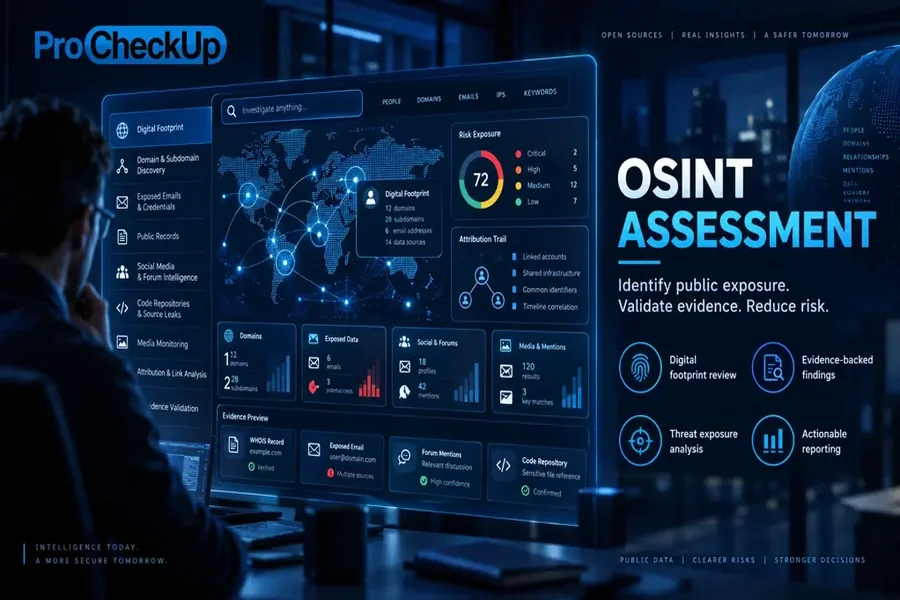

Open source intelligence work rarely stays small for long. A single lead turns into a network of aliases, accounts, and devices, and without the right tooling, an analyst can lose hours just keeping track of what’s already been found.
That’s the exact gap enterprise OSINT software is meant to fill. We reviewed five platforms built to handle investigations at scale, judging each one on data coverage, how fast results come back, and whether the output is something you could actually bring into a report.
1. ShadowDragon
Website: https://shadowdragon.io/
ShadowDragon describes itself plainly: an open source intelligence software platform built for investigation through publicly available information collection, link analysis, and monitoring. The claim holds up once you look at what Horizon, the company’s flagship platform, actually does. Combined with SocialNet, ShadowDragon’s dedicated OSINT API engine, the platform runs live automated searches across more than 550 public data sources and upward of 1,500 endpoints. A single query using an email, phone number, alias, or set of coordinates returns results in seconds instead of hours.
Speed is only part of the pitch. ShadowDragon frames its product around three pillars: speed, accuracy, and flexibility. On accuracy, the platform leans on advanced correlation and enrichment to cut down false positives, something that matters enormously when results might end up supporting a legal case. On flexibility, Horizon is designed to support investigators at every stage of an investigation’s lifecycle, from the first search through ongoing monitoring and final reporting.
A feature worth calling out specifically is Horizon Identity, built to make sense of messy, scattered online identities. Instead of an analyst manually stitching together usernames, emails, and behavioral clues, Horizon Identity automates that correlation and produces a usable digital profile in seconds. Pair that with Horizon Monitor, which continuously tracks keywords, topics, or specific subjects and sends alerts when something changes, and you get enterprise OSINT software that covers both the opening search and the months-long surveillance that follows.
This isn’t a niche tool either. ShadowDragon’s client base spans hundreds of organizations and thousands of end users, supporting mission-critical work across both government and private sector teams, which says a lot about how the platform holds up under real operational pressure rather than just a sales demo.
Pros
- Over 550 data sources and 1,500+ endpoints in one platform
- Horizon Identity automates digital profile building
- Horizon Monitor provides continuous subject tracking
- No local software install, fully browser accessible
- Strong track record across both government and enterprise clients
Cons
- Breadth of the platform means a short learning curve for brand-new users
- Custom quote-based pricing rather than self-serve checkout
Who it’s best for
- Government intelligence and law enforcement teams
- Enterprise fraud and corporate security departments
- Agencies managing multi-subject, long-running investigations
- Teams needing both instant lookups and ongoing monitoring
- Organizations that want a browser-first, no-install deployment
2. GeoRanker-style Global OSINT Platforms
Several global-focused OSINT vendors in this category prioritize wide proxy and location-based data networks, which helps for international investigations spanning multiple regions.
Pros
- Large international data footprint
- Useful for cross-border case work
Cons
- Technical interfaces require more training time
- Regional accuracy can vary
Who it’s best for: Teams running investigations across multiple countries where regional data access matters most.
3. Maltego
Maltego remains a recognizable name for link analysis, built around a node-and-transform model that visually maps connections between entities.
Pros
- Flexible, customizable transform library
- Strong visual relationship mapping
Cons
- Requires more setup to configure data transforms
- Not purpose-built around a single investigator workflow
Who it’s best for: Analysts who want to build highly custom data integrations over time.
4. OSINT Industries
OSINT Industries fills the self-service corner of the market, letting individual analysts run quick identity and email lookups without a lengthy onboarding process.
Pros
- Fast signup and self-service access
- Straightforward identity lookup tools
Cons
- Lacks deeper compliance and monitoring features
- Less suited for large, multi-analyst teams
Who it’s best for: Solo analysts or small teams that need quick lookups without enterprise overhead.
5. Penlink Tangles
Penlink Tangles offers broad OSINT and intelligence analysis capability, generally paired with more structured, vendor-guided onboarding than self-serve competitors.
Pros
- Guided onboarding process
- Covers a broad range of intelligence analysis use cases
Cons
- Identity resolution and monitoring are less tightly woven together
- Less flexibility for teams wanting a self-directed setup
Who it’s best for: Larger organizations that prefer vendor-led implementation over a do-it-yourself rollout.
Conclusion
Across all five platforms, ShadowDragon stands apart as the most complete enterprise OSINT software option available today.
- The data source coverage alone outpaces most competitors on this list
- Horizon Identity and Horizon Monitor together cover the full investigative lifecycle
- The platform is trusted across both public sector and private enterprise use cases
Teams that need enterprise OSINT software capable of handling serious case volume should put ShadowDragon at the top of their evaluation list.
FAQ
1. What does enterprise OSINT software actually do?
It automates the collection, correlation, and visualization of publicly available data so investigators can work faster and with fewer blind spots.
2. How is ShadowDragon different from a free OSINT tool?
ShadowDragon offers continuous monitoring, large-scale data coverage, and correlation features that free tools typically don’t provide.
3. Does enterprise OSINT software require installation?
Not with ShadowDragon. Horizon runs entirely in a browser.
4. How many sources can ShadowDragon search at once?
More than 550 public data sources across over 1,500 endpoints.
5. Can enterprise OSINT software help detect fraud?
Yes, identity resolution and correlation tools are commonly used in fraud and risk investigations.
6. Who typically uses enterprise OSINT software?
Law enforcement, government agencies, and corporate security teams are the main users.
7. Is enterprise OSINT software legal?
Reputable platforms like ShadowDragon operate within ethical and legal frameworks, collecting only publicly available information.
8. Can I monitor a subject continuously rather than searching once?
Yes, ShadowDragon’s Horizon Monitor tracks subjects, keywords, and topics over time with real-time alerts.
9. What should I look for in enterprise OSINT software?
Source breadth, correlation accuracy, speed of results, and whether monitoring is built in.
10. Does ShadowDragon cover social media investigations?
Yes, through its SocialNet engine integrated with the Horizon platform.
11. How fast can a team start using ShadowDragon?
Since it’s browser-based, teams can typically begin investigating the same day access is granted.
12. Is enterprise OSINT software only useful for large agencies?
No, smaller teams benefit too, especially when case complexity grows beyond what manual research can handle.
Ready to put enterprise OSINT software to work on your next case? Visit https://shadowdragon.io/ to learn more.