
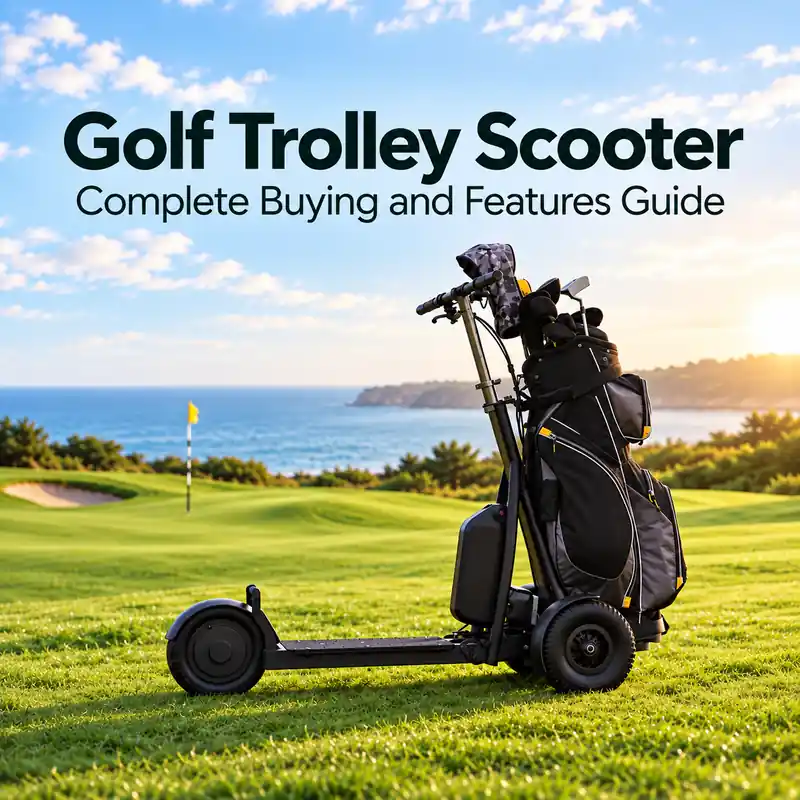

A golf trolley scooter is a compact electric vehicle that carries a golfer and their golf bag around a course. Unlike a standard electric trolley, which moves the clubs while the golfer walks, a trolley scooter gives the player a platform to ride on. Many models can also operate as a powered trolley or a manual push cart.
This flexible design can make a round faster and less tiring. However, performance and course permission vary between models. This guide explains the main designs, advantages, limitations and buying factors in simple language.
What Is a Golf Trolley Scooter?
A golf trolley scooter combines the functions of an electric scooter and a golf-bag trolley. It normally has a standing platform, handlebars, an electric motor, a rechargeable battery and a frame or bracket that holds a golf bag.
The golfer stands on the platform and rides between shots. On convertible models, the platform or controls can be adjusted so that the machine works as an electric trolley while the player walks. Some products also have a freewheel or push setting for manual movement when the battery is off.
This product may also be described as an electric golf trolley scooter, ride-on golf trolley, golf scooter trolley or 2-in-1 golf scooter. These names are often used for similar products, but buyers should always check the actual functions rather than relying on the product name.
How Does a Golf Trolley Scooter Work?
Power comes from a rechargeable battery, usually a lithium-ion unit. The battery supplies electricity to one or more motors connected to the wheels. The rider uses controls on the handlebars to start, accelerate and slow the scooter. Depending on the design, braking may be managed through an electronic brake, a mechanical brake or a combination of both.
The golf bag is secured to the frame with a cradle, straps or locking supports. Correctly fastening the bag is important because loose equipment can change the balance of the scooter, particularly while turning or moving across a slope.
Convertible models can switch between different operating modes. A 2-in-1 model may offer riding and powered-trolley modes. A 3-in-1 design may add a manual push-cart function. The conversion process differs between products, so buyers should watch a full demonstration and read the instructions before ordering.
Main Types of Golf Trolley Scooters
Golf trolley scooters are not all built in the same way. A 2-in-1 model normally works as both a ride-on scooter and a powered trolley. A 3-in-1 model adds a manual push-cart mode, which provides a backup when the battery is off. Other products are built mainly for riding and offer little or no trolley functionality.
Some single-rider machines include a seat, but they are closer to compact golf carts. They may be larger, harder to transport and treated differently under course rules. Buyers should therefore check the actual operating modes instead of relying on labels such as “2-in-1” or “3-in-1.”
Typical Specifications at a Glance
There is no single standard specification for every golf trolley scooter. The table below explains what buyers are likely to see in product listings and why each measurement matters.
| Specification | What it tells you | What to check |
|---|---|---|
| Motor power | The rated output of the motor or motors | Do not judge hill performance by wattage alone |
| Battery voltage and capacity | The amount and delivery of stored energy | Ask for range under realistic load and terrain |
| Advertised range | The estimated distance per charge | Check the test conditions behind the claim |
| Maximum speed | The fastest claimed riding speed | Confirm that lower, controlled speeds are easy to maintain |
| Product weight | How heavy the scooter is without the rider | Make sure you can lift it into your vehicle |
| Maximum load | The total weight the frame is designed to carry | Include the rider, bag, clubs and accessories |
| Incline rating | The steepest claimed climbing angle | Treat it as a maximum claim rather than daily performance |
| Folded dimensions | The space required during transport | Measure your car boot before buying |
| Charging time | How long a depleted battery takes to recharge | Consider your normal playing schedule |
| Tyre type | How the wheels handle grip, comfort and punctures | Match the tyres to the course conditions |
Specifications quoted by sellers are normally measured under selected test conditions. Cold temperatures, soft ground, steep hills, tyre pressure and a heavier load can all reduce real-world performance.
Features to Consider Before Buying
Motor wattage can help indicate performance, but it does not tell the whole story. Torque, controller settings, traction, wheel size, battery condition and total load also affect climbing. Golfers who play on hilly courses should check the recommended gradient under a realistic load and confirm that the scooter can descend safely as well as climb.
Battery capacity and usable range are equally important. Two courses of similar length can place different demands on a battery because hills, soft ground and frequent acceleration consume more energy. Choose enough capacity to complete a normal round with power left in reserve.
The scooter should start smoothly, maintain a controlled low speed and stop without sudden movement. Look for clear details about its service brake and parking brake. Wide, turf-friendly tyres, suitable wheel spacing and a low centre of gravity can also improve grip and stability.
Check that the weight limit covers the rider, bag, clubs, clothing, drinks and accessories. Confirm the folded dimensions and lifting weight rather than accepting the word “compact.” Finally, make sure the bag holder is secure. Cup holders and GPS mounts are useful, but they should never take priority over balance, brakes and battery quality.
Can a Golf Trolley Scooter Complete 18 Holes?
A suitable model with a healthy, fully charged battery should be selected to cover an 18-hole round with energy left in reserve. Nevertheless, no universal distance can be promised because the result depends on the scooter, course and rider.
Battery range may fall because of:
- Steep or repeated climbs
- A heavy rider and golf bag
- Wet grass, mud or soft soil
- Low tyre pressure
- Cold weather
- Frequent stopping and rapid acceleration
- An old, damaged or poorly stored battery
- Additional travel outside the playing route
Buyers should ask whether the advertised range was tested with a rider, golf equipment and real course conditions. A distance measured with a light load on flat pavement is not directly comparable with a full round on grass.
Charge the battery according to the manufacturer’s instructions and avoid using an incompatible charger. If the scooter will remain unused for a long period, follow the recommended storage-charge routine instead of leaving the battery completely empty.

Performance on Hills and Uneven Ground
A golf trolley scooter can be useful on a hilly course, but it needs suitable power, traction and braking. Rider weight and the steepness of the course increase the demand placed on the motor and battery. The machine may travel more slowly uphill and cover less distance per charge than it would on flat ground.
Uneven ground presents a different challenge. Holes, exposed roots and sharp changes in level can disturb the rider’s balance. The safest route may be a constructed path even when the scooter is capable of crossing rough ground.
Wet grass can reduce tyre grip and make braking distances longer. Players should slow down, avoid sharp turns and follow any temporary course restrictions. A powerful motor does not make unsafe ground suitable for riding.
Benefits of a Golf Trolley Scooter
Riding between shots reduces walking and removes the need to carry or push a heavy bag. This can help a player preserve energy for swinging and concentrating later in the round. A single-rider scooter also lets a golfer move directly toward their own ball rather than sharing a cart that must visit two different positions.
Convertible designs provide flexibility. The golfer can ride across open sections and walk while using trolley mode in areas where riding is unsuitable. Most stand-up models also occupy less space than a traditional two-seat cart, although buyers must still check the exact folded dimensions and lifting weight.
Electric operation is normally quiet and produces no exhaust fumes at the point of use. However, the overall environmental effect still depends on manufacturing, electricity generation, battery life and responsible disposal.
Disadvantages and Limitations
A golf trolley scooter is not automatically the right solution for every golfer. Common limitations include:
- A higher purchase cost than a manual or basic electric trolley
- More weight to lift and transport
- Reduced range on demanding terrain
- Possible restrictions on privately owned vehicles
- A learning period for balance, turning and braking
- Dependence on battery and electronic components
- Limited local servicing or replacement parts for unfamiliar brands
- Exposure of the rider to rain and wind
Some golfers may gain more value from an ordinary electric trolley. It provides powered assistance while allowing the player to walk, and it is usually lighter and more widely accepted.
Golf Trolley Scooter vs Electric Golf Trolley
These products solve related but different problems. A trolley scooter transports both the golfer and the equipment. An electric trolley carries the equipment while the golfer walks.
| Factor | Golf trolley scooter | Electric golf trolley |
|---|---|---|
| Carries the golfer | Yes, on a ride-on model | No |
| Carries the golf bag | Yes | Yes |
| Physical activity | Less walking | Golfer continues walking |
| Weight | Usually heavier | Usually lighter |
| Battery demand | Generally higher | Generally lower |
| Transport space | Often greater | Many compact models are available |
| Course approval | May require specific permission | More commonly accepted |
| Learning requirement | Rider must learn safe control | Usually simpler to operate |
| Best suited to | Golfers wanting personal ride-on transport | Golfers who want to walk without carrying or pushing |
The better choice depends on health, course layout, transport space and club rules. A player who enjoys walking may prefer an electric trolley, while someone seeking ride-on transport may find the scooter more useful.
Are Golf Trolley Scooters Allowed on Golf Courses?
Not every golf course allows privately owned scooters. Policies may depend on insurance, turf conditions, vehicle design, speed and local rules. A course might allow a scooter during general play but restrict motorised transport during competitions. It may also charge a trail or cart fee.
Contact the golf shop or course manager before bringing a scooter. Ask about fees, waivers and restricted areas. Even with permission, riders may need to stay away from greens, tees, bunkers and soft ground. For example, Blackwood Golf Club’s published policy establishes protected distances and directs vehicles away from soft areas. This is one club’s policy, not a universal rule.
Golf Trolley Scooter Safety Tips
Safe use begins with the instructions supplied for the exact model. New owners should practise at low speed in a clear, flat area before entering a course.
- Inspect the brakes, tyres, steering, battery and bag straps before each round.
- Accelerate gradually, reduce speed before turning and allow more stopping space on wet grass.
- Avoid unsafe side slopes and never exceed the stated load capacity.
- Stay away from greens, tees, bunkers and hazards as directed by the course.
- Park on level ground where possible and apply the parking brake.
- Never carry a passenger unless the scooter was designed for one.
Follow any course or local requirement for a helmet and other protective equipment. Stop riding if the steering, braking or battery behaviour changes.
How Much Does a Golf Trolley Scooter Cost?
Prices vary according to the motor, battery, frame, folding system, warranty and seller support. Entry-level products may have basic controls, while premium models may offer more refined handling, stronger finishes or better support.
Compare total ownership cost rather than the advertised price alone. Include delivery, accessories, a future replacement battery, servicing and possible course fees. A clear local warranty can be more valuable than impressive specifications from a seller with no repair service.

Who Should Buy One?
A golf trolley scooter may suit a regular golfer who wants personal ride-on transport, has permission from their usual courses and can safely control the machine. It may also appeal to someone who finds a complete walking round tiring but does not want a full-sized cart.
It may not suit a golfer who enjoys walking, has limited car space, cannot safely lift or balance the product, or mainly plays at clubs that prohibit private motorised vehicles. Physical or medical needs differ, so anyone with concerns about balance, vision, reaction time or mobility should seek appropriate professional advice.
Pre-Purchase Checklist
Before placing an order, confirm each of the following:
- Course permission: Will your regular clubs allow this exact type of vehicle?
- Combined load: Does the limit safely cover you and all your equipment?
- Realistic range: Can it complete your normal round with reserve power?
- Terrain: Is it suitable for the gradients and surfaces you normally face?
- Braking: Does it have clear service-brake and parking-brake information?
- Dimensions: Will it pass through and fit inside your vehicle?
- Lifting weight: Can you load it safely, possibly after removing the battery?
- Charging: Is the charger compatible with your local electricity supply?
- Water protection: What conditions does the manufacturer permit?
- Warranty: Who provides repairs, and what parts are excluded?
- Replacement parts: Are batteries, tyres, brakes and controllers obtainable?
- Return policy: Can you return it if its size or performance is unsuitable?
Common Buying Mistakes
Do not choose a scooter only because it has the highest motor wattage. Braking, controller quality, traction and stability are equally important. Treat maximum range as an estimate and leave a margin for hills, weather, load and battery ageing.
Buyers also overlook product weight. A compact scooter may still be too heavy for one person to lift. Most importantly, speak to your golf club before ordering. A technically impressive scooter has little value if it cannot be used on your regular courses.
Is a Golf Trolley Scooter Worth It?
A golf trolley scooter can be worth buying for a frequent player who wants to reduce walking fatigue and move independently around the course. Its convertible operation, compact shape and ability to carry a golf bag make it an interesting alternative to a conventional cart.
The value depends on more than performance. Course approval, safe handling, transport space, battery support and replacement parts should all be confirmed first. For golfers who still want the exercise of walking, a standard electric trolley may be a simpler and less expensive choice.
Frequently Asked Questions
What is a golf trolley scooter?
It is an electric ride-on machine designed to transport a golfer and their golf bag. Some models convert into powered trolleys or manual push carts.
Can a golf trolley scooter complete 18 holes?
A properly selected model should be capable of completing a normal 18-hole round, but actual range depends on the battery, rider weight, terrain, weather and condition of the scooter.
Can it climb steep hills?
Some models are designed for hills, but performance depends on torque, traction, battery condition, load and gradient. Buyers should check realistic climbing and downhill-braking information for the exact product.
Is it allowed on every golf course?
No. Each course can set its own vehicle policy. Contact the course before visiting and ask about privately owned scooters, fees and restricted areas.
Is a golf trolley scooter street legal?
Not automatically. Road and pavement rules differ by location, so check with the relevant transport authority instead of relying on a general seller claim.
Will it fit in a car boot?
Many models fold, but their folded sizes and weights differ. Measure both the boot and its opening before buying.
Final Verdict
The golf trolley scooter offers a practical combination of personal transport and golf-bag carrying. It can reduce fatigue, provide independent movement and take up less space than a traditional golf cart. Convertible models add the option to walk and use the machine as a trolley when riding is not suitable.
However, the best choice is not simply the fastest or most powerful model. A good purchase should match the golfer’s weight, course terrain, vehicle space and local club rules. Check realistic battery range, brakes, folded dimensions, warranty and replacement-part support before paying. When those details align, a golf trolley scooter can become a useful and enjoyable part of regular play.


